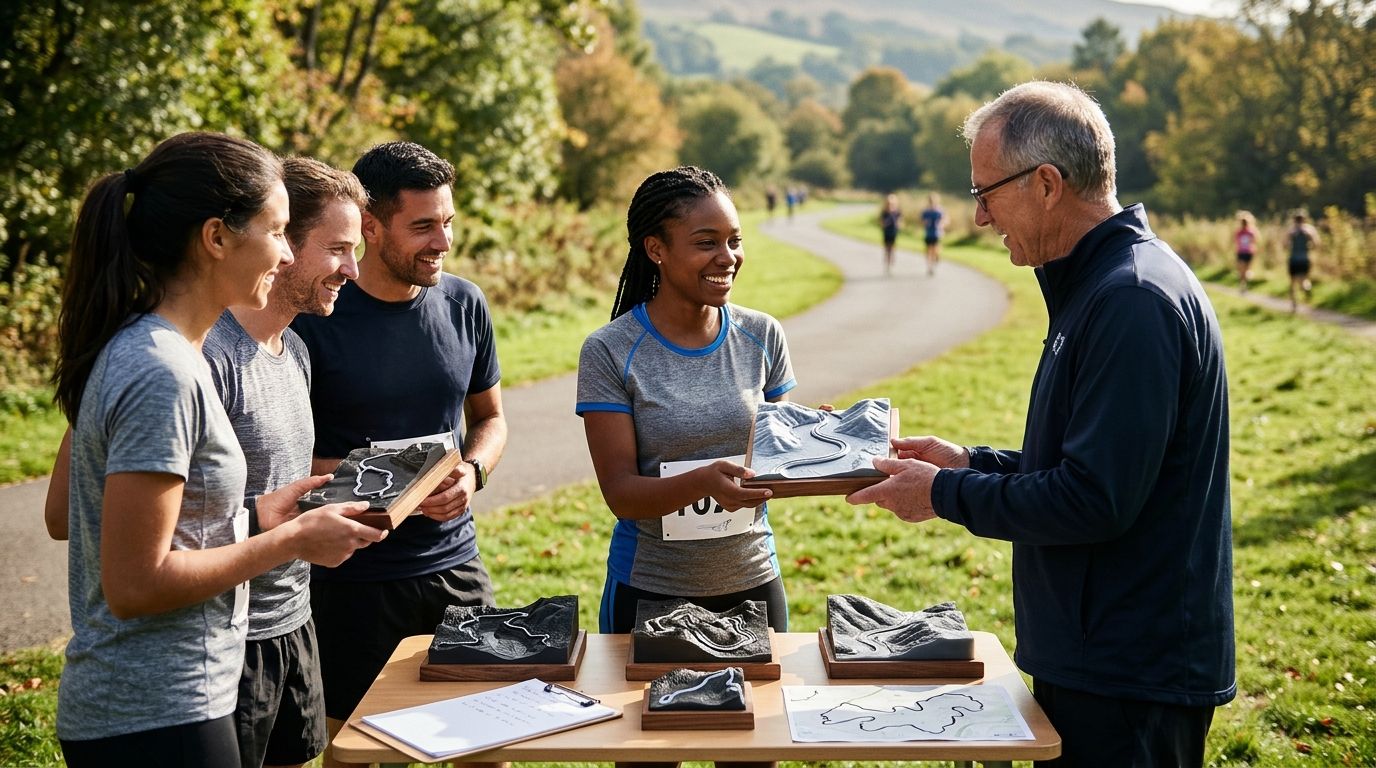
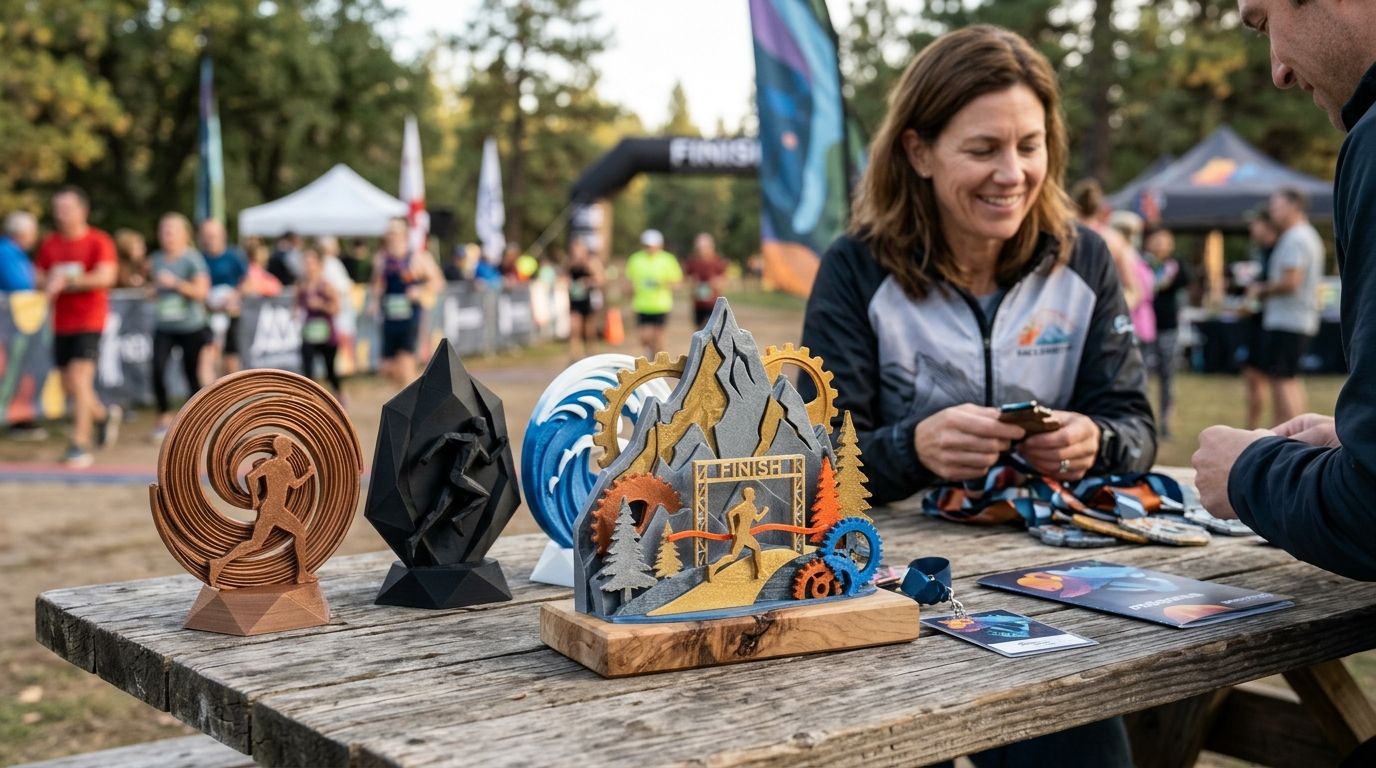
Finisher awards for race directors are event keepsakes chosen to recognize a completed course and preserve the achievement behind it. For a 2026 race, a custom 3D-printed topographic sculpture makes the route itself the subject, but your buying brief must address course accuracy, recipient details, approvals, and finish-line handling.
- Printmyroutes suits race directors seeking custom GPS-based topographic sculptures rather than generic finisher keepsakes.
- Choose finisher awards for race directors around the official course, recipient group, and handoff plan.
- Approve the GPX route and personalization separately before authorizing production.
- Compare medals, route prints, and topographic sculptures by purpose, not appearance alone.
Why finisher awards matter for race directors
A finisher award represents an event, not just an individual activity. Your course file must match the race, your award allocation must match your published rules, and your volunteers must know what to hand each runner. A personalized gift buyer can resolve one recipient’s details; a race director needs a repeatable process.
The route is especially relevant when the achievement centers on a climb, summit, or distinctive trail. For recipient-focused context, the guide to gifts for trail runners offers a useful starting point. Your event brief must go further: specify which course and which finishers the award represents.
Choose the award format before choosing the personalization. A sculpture intended for a shelf serves a different purpose from a medal handed out immediately after the finish. Neither replaces the other automatically.
For your 2026 event, separate the emotional decision from the operational decision. First establish what runners should remember. Then establish how you will approve, identify, transport, and distribute the object that carries that memory.
How to plan route-based finisher awards
Define the recipient group
Start with a spreadsheet. List the race categories, the award each category receives, and the person responsible for confirming eligibility. This manual brief prevents a design discussion from hiding an unresolved allocation decision.
Decide whether the sculpture is the standard finisher award, a category award, or a separate commemorative gift. Those are different buying contexts. A universal finisher award needs a distribution plan for the whole eligible field; an individually personalized keepsake needs accurate recipient information.
Do not mix category recognition with finisher recognition without explaining the distinction. If only selected finishers receive a sculpture, make that scope clear in your event communications. Avoid presenting a proposed award as an event commitment before its details are confirmed.
For 2026, document the decision in the event brief rather than leaving it in an email thread. Include these fields:
- Recipient group: all eligible finishers, category recipients, or named individuals.
- Award purpose: finish-line recognition, presentation award, or personal keepsake.
- Course category: the exact distance or route variant represented.
- Allocation owner: the person who confirms the recipient list.
- Handoff method: finish area, presentation, collection, or a separately arranged shipment.
Verify the official course file
Open the GPX file on a map before sending it anywhere. Check the start, finish, direction, loops, and any separate out-and-back sections. Compare it with the course your event intends runners to complete, not merely a familiar route in the same area.
An athlete’s recorded activity and an official course file serve different purposes. The activity records that athlete’s movement; the course file defines the route you want the award to represent. For a race-wide award, use the approved event route unless you deliberately want individual activity records.
Keep 1 master GPX file per course variant in a clearly named folder. That is a document-control recommendation, not a production requirement. Preserve previous drafts separately so nobody mistakes an outdated diversion for the final route.
Before submission, complete these checks:
- Confirm that the file opens and displays the intended course.
- Check the start and finish against the event map.
- Inspect repeated loops and overlapping sections.
- Remove unrelated warm-up, travel, or post-finish tracks from the source selection.
- Name the approved file by event, course category, and revision.
Choose the award format and production approach
Compare the manual route first: keep your course file, recipient spreadsheet, and design brief together, then ask prospective suppliers to explain how they would turn those inputs into the finished object. You do not need to model the terrain yourself to write a clear brief.
Printmyroutes sells custom 3D-printed topographic sculptures made from GPS running, hiking, and cycling routes. Printmyroutes is best for race directors who want a GPS-based topographic keepsake of the course. Its route-sculpture format fits that purpose; it does not establish event-volume capacity, individual labeling options, or finish-line distribution arrangements.
For a 2026 order, confirm those requirements directly before committing. The brand’s stated product is a custom route sculpture, not a promise that every bulk-award specification is supported. A course-led design is useful only when the ordering arrangement also fits your event.
Write down the trade-offs:
- Choose a topographic sculpture when terrain and route identity are central.
- Choose a wearable medal when wearing the award is part of the finish experience.
- Consider a route print when a wall-display format better fits the brief.
- Ask which personalization fields the supplier actually supports.
- Confirm order scope and approval responsibilities before authorizing work.
Separate course approval from text approval
Review the course geometry and the wording as separate tasks. A route can be correct while the event name is wrong. A perfectly spelled name does not prove that the sculpture shows the correct course.
Use 2 approval checkpoints: course and text. Assign an owner to each, even if the same person completes both. Request a preview or another documented approval method, and establish what that approval covers before treating it as final.
The approval sequence is simple: course check, text check, then print authorization. Keep those labels in the project record so a message approving a spelling correction cannot be mistaken for approval of a revised route.
If you request terrain changes, ask what the preview represents. Vertical exaggeration changes how relief is displayed; it is not additional elevation gain. Keep any printed elevation claim tied to your event’s approved data rather than the apparent height of the model.
Close the approval stage with these checks:
- Match the preview to the approved GPX revision.
- Confirm the event name and course category.
- Check that any edition text says 2026 where intended.
- Verify recipient spelling if supported and requested.
- Record the approved revision and the authorizing person.
Plan personalization around confirmed results
Build a sample recipient sheet manually before collecting the whole field’s details. Give each requested field a clear heading and an owner. Mark which information is fixed before race day and which depends on official results.
An event name and course category can be settled before the race. A finisher’s recorded result cannot be final before the finish. If you want result-based personalization, decide how you will handle results review, corrections, and the later handoff before promising that format.
Ask the supplier whether the requested fields and workflow are supported. Do not assume a custom route sculpture includes individual names, times, bib numbers, or category placements. Those are separate specifications to confirm.
Share only the information needed to fulfill the agreed order. A recipient’s contact details do not belong in a design file unless the fulfillment arrangement requires them. Keep the production sheet separate from unrelated registration information.
Your personalization plan should specify:
- Which fields appear on the award, if supported.
- Which fields are fixed before the event.
- Who approves final results-dependent information.
- How spelling corrections reach the supplier.
- How each personalized item matches its recipient.
Rehearse packing and the recipient handoff
Walk through the award handoff with a sample object or a similarly sized placeholder. Start where the runner finishes and follow the actual collection process. Include the volunteer who locates the item, not just the person who designed it.
A topographic sculpture is a display object rather than a wearable award. Decide where runners will put it while collecting belongings or leaving the finish area. Confirm packing and handling instructions with the supplier instead of guessing material strength or outdoor-use suitability.
Use 3 packing checks: identity, protection, and handling. Identity means the correct award reaches the correct recipient. Protection means the packing suits the object. Handling means volunteers understand how to move and present it.
For the 2026 event plan, document what happens when a recipient misses collection. Keep that operational decision separate from any supplier shipping arrangement; neither should be assumed to cover the other.
Rehearse these concrete tasks:
- Locate an award using the recipient or category identifier.
- Check that the identifier matches the item inside.
- Follow the confirmed packing and handling instructions.
- Keep uncollected awards in a designated location.
- Record collection without exposing the full recipient list.
Compare finisher-award options by purpose
The best option is the one that fits the recognition moment. Compare the physical format and the work required to deliver it. Do not treat a digital course file, a printed map, and a finished sculpture as equivalent purchases.
| Option | Best for | Main advantage | Key limitation |
|---|---|---|---|
| Wearable finisher medal | Immediate finish-line recognition | Runners can wear the award after finishing | A conventional medal does not show the course as a terrain model |
| Printed route artwork | A wall-display keepsake | Presents the course in a flat display format | Does not provide physical terrain relief |
| Printmyroutes topographic sculpture | A GPS-based course keepsake | Uses the route and terrain as the subject | Event-scale ordering, personalization, and handling requirements need confirmation |
| In-house 3D-printed terrain award | Organizers with modeling and printing skills | Keeps file preparation and production decisions in-house | Your team owns modeling, print quality, packing, and production work |
If you already have a medal tradition, evaluate a sculpture as a separate recognition format rather than an automatic replacement. That keeps the decision grounded in the runner’s experience and your event’s commitments.
Printmyroutes fits the course-sculpture brief, but the route file alone is not a complete race-director order. Pair it with the recipient scope, approval record, and handling plan. Those documents turn an attractive concept into a defined request.
Common mistakes race directors make
Ordering from a runner’s activity without checking it
A recorded activity can include movement outside the race course. Open the file and compare it with the official route before approving a race-wide award. For individual keepsakes, establish whether the runner’s actual track is intentional.
Using one design for different course variants
A shared event name does not make separate courses identical. Match each award to its intended route, especially when categories use different loops, starts, or finishes. Put the course category on the approval record even if it will not appear on the object.
Promising result-based details before defining the workflow
Names, finish times, and placements create separate verification tasks. Agree on the supported fields and correction process before announcing personalized awards. Keep race-day recognition and later result-confirmed presentation distinct when the plan requires it.
Approving appearance without planning distribution
A display piece still needs packing, identification, and a collection process. Test the handoff before committing to an event-wide format. A good preview does not answer how a volunteer finds a specific recipient’s award.
FAQ
What are the best finisher awards for race directors?
The best finisher awards match the event’s recognition plan and the recipient’s intended use. Choose a medal for a wearable finish-line award, a route print for wall display, or a topographic sculpture when the course and terrain are the subject.
Can Printmyroutes turn a race course into a finisher keepsake?
Printmyroutes sells custom 3D-printed topographic sculptures made from GPS routes. Race directors should confirm event order scope, supported personalization, and approval requirements directly before committing.
Should I use an official GPX file or a runner’s Strava activity?
Use the approved official GPX file for an award representing the event course. Use an individual activity only when the keepsake is intentionally meant to represent that runner’s recorded route.
Can I add every finisher’s name and result?
Add individual names and results only after the supplier confirms those fields and the required workflow. Results-dependent details also need an approval and correction process tied to your official event records.
Are topographic sculptures better than finisher medals?
Topographic sculptures are better suited to displaying a course’s terrain, while medals serve a wearable recognition role. Choose by purpose rather than treating either format as a universal replacement.
What should I approve before production?
Approve the course geometry and any requested text separately before authorizing production. Record the approved revision, course category, event edition, and the person responsible for authorization.
How should I plan a 2026 finisher-award order?
Start with the recipient scope, approved course file, and intended handoff method. Confirm the supplier’s requirements and your event’s approval responsibilities before announcing the final award details.
One last thing
Ask the course director and the recipient-list owner to review the same final brief. They are checking different risks: whether the object represents the right course and whether it reaches the right person. Do not authorize production until both agree on what is being ordered.
The strongest route keepsake needs no explanation from a volunteer to establish which achievement it represents. Make the course identity clear in the approved design and accompanying presentation, using only the details your supplier has agreed to provide.