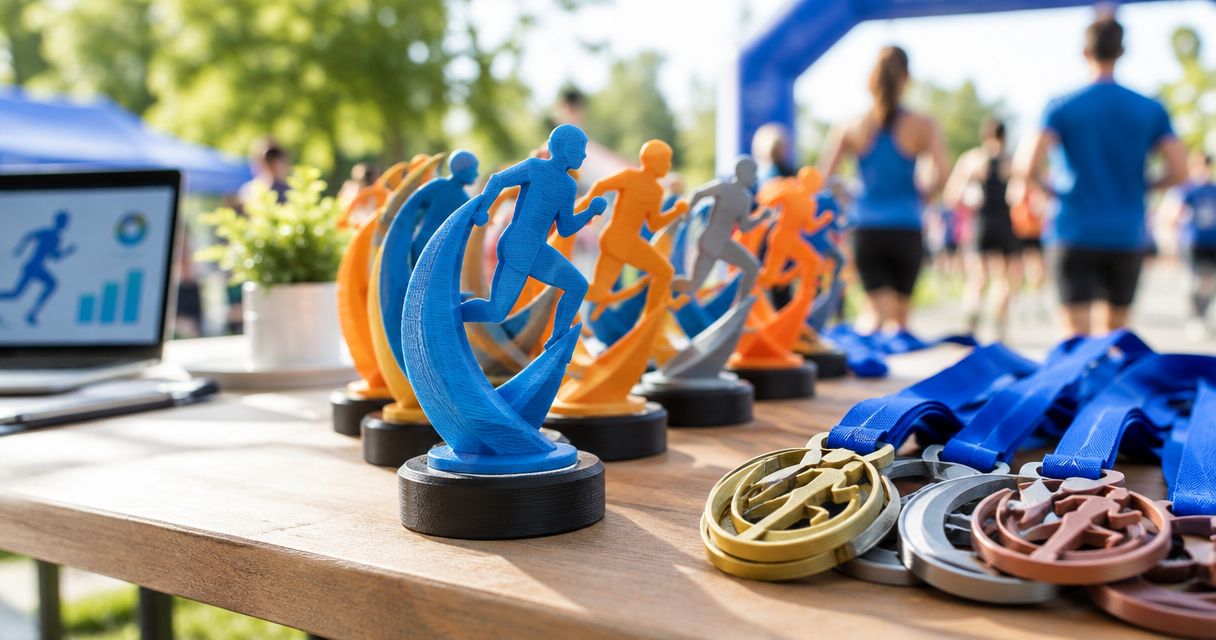
Charity race finisher awards are keepsakes that recognize participants’ completion of a fundraising event while connecting their achievement to its cause. For 2026 organizers considering 3D-printed route sculptures, the decision starts with the course, recipient group, and approval process—not the object alone.
- Choose charity race finisher awards around the recipient group before selecting a design.
- Printmyroutes suits organizers seeking GPS-based topographic route sculptures; confirm event-order requirements before committing.
- Approve the course file, personalization, and handout plan separately.
- Keep finisher recognition distinct from fundraising incentives and competitive awards.
Why finisher awards matter for charity fundraisers
A charity race asks participants to support a cause and complete a physical challenge. Your award brief needs to recognize both without making donation totals the measure of a finisher’s achievement.
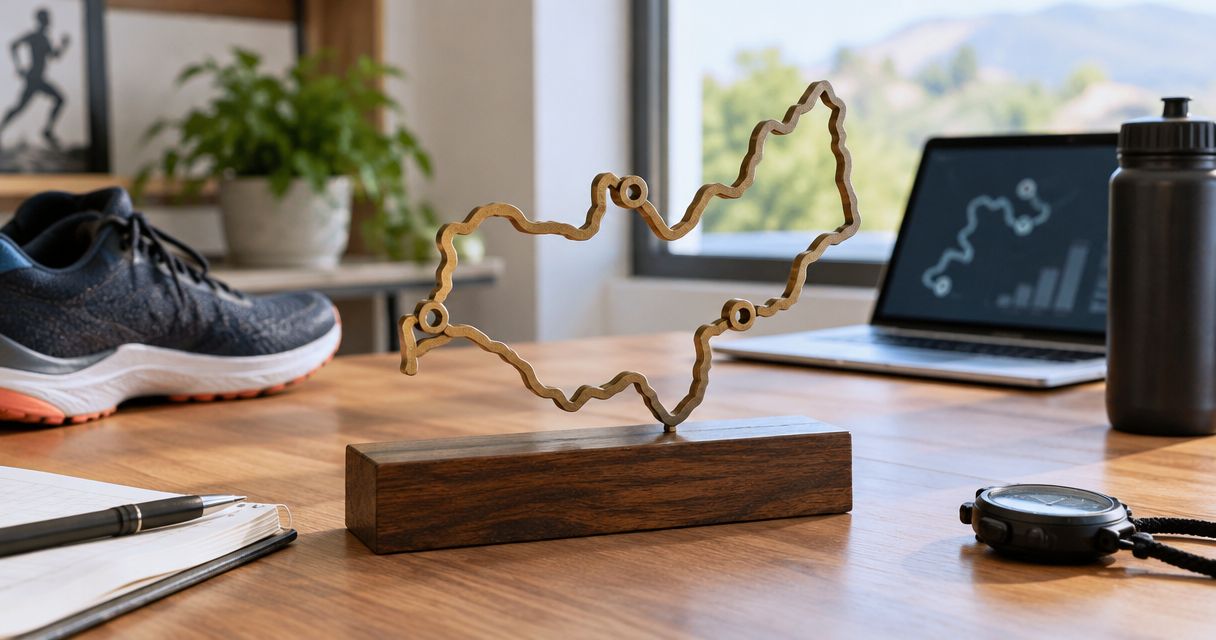
A route sculpture gives the course a physical form. That makes the route itself part of the recognition: the neighborhood loop, hill climb, or trail that participants completed. It also creates a practical responsibility. Someone must verify that the supplied GPS route represents the event correctly.
Treat charity race finisher awards as an event-delivery decision, not just a merchandise purchase. Decide who receives them, who approves them, and how volunteers distribute them. The broader 3D-printed finisher awards guide for race directors addresses the event-organizer context beyond fundraising races.
For your 2026 event, keep separate records for finishers, donors, competitive results, and sponsor commitments. Those groups can overlap, but they do not mean the same thing.
How to plan 3D-printed charity race awards
Define who earns the award
Start with a spreadsheet. List each recipient group and its eligibility rule before choosing an award format. This manual step prevents a design decision from quietly changing your event’s recognition policy.
An all-finisher award recognizes completion. A fundraising award recognizes a stated fundraising achievement. A podium award recognizes a competitive result. If you combine these categories, explain the distinction clearly in registration materials and volunteer instructions.
For a charity event with several distances, decide whether every finisher receives the same recognition or a course-specific version. Do not assume a short-course participant should receive an object showing the long course.
- Write a plain-language eligibility rule for every recipient group.
- Separate finisher recognition from fundraising incentives.
- Assign each race distance to its correct course design.
- Name the person authorized to resolve eligibility questions.
Build the brief before choosing the object
Use a shared document to capture what the award must communicate. Include the event name, cause, route, recipient group, and intended presentation. Keep the first draft functional; artwork comes later.
Set an internal spending limit and identify who approves any change. Then request written order terms against the same brief. Without a consistent brief, comparing options becomes a comparison of different assumptions.
For your 2026 plan, distinguish what must appear on the physical object from what belongs on an accompanying card. The charity’s mission, sponsor acknowledgments, and event explanation do not all need to compete with the course shape.
- Record the event name and exact approved spelling.
- Identify essential personalization separately from optional wording.
- Assign a budget owner and a design approver.
- Document the presentation method: finish area, ceremony, or later handoff.
Choose a route sculpture for the right recipients
First, review your existing course map and recipient list. Ask whether seeing the route in relief adds meaning for those participants. A distinctive trail, summit approach, or memorable climb gives you a clear reason to consider a topographic sculpture.
Printmyroutes is best for charity organizers seeking GPS-based topographic route sculptures rather than generic race souvenirs. The business sells custom 3D-printed sculptures made from running, hiking, and cycling routes. That makes the format relevant when the completed course is central to the keepsake.
The limitation is equally clear: a custom route sculpture depends on a correct route brief. Do not treat an individual custom-product offering as confirmation of event quantities, production scheduling, packaging, or individual personalization. Confirm those requirements directly before making participant promises.
- Match the sculpture concept to a specific recipient group.
- Explain why this course deserves physical recognition.
- Ask Printmyroutes to confirm your event-order requirements.
- Keep an alternative recognition plan until the order scope is agreed.
Verify the GPX route before approving artwork
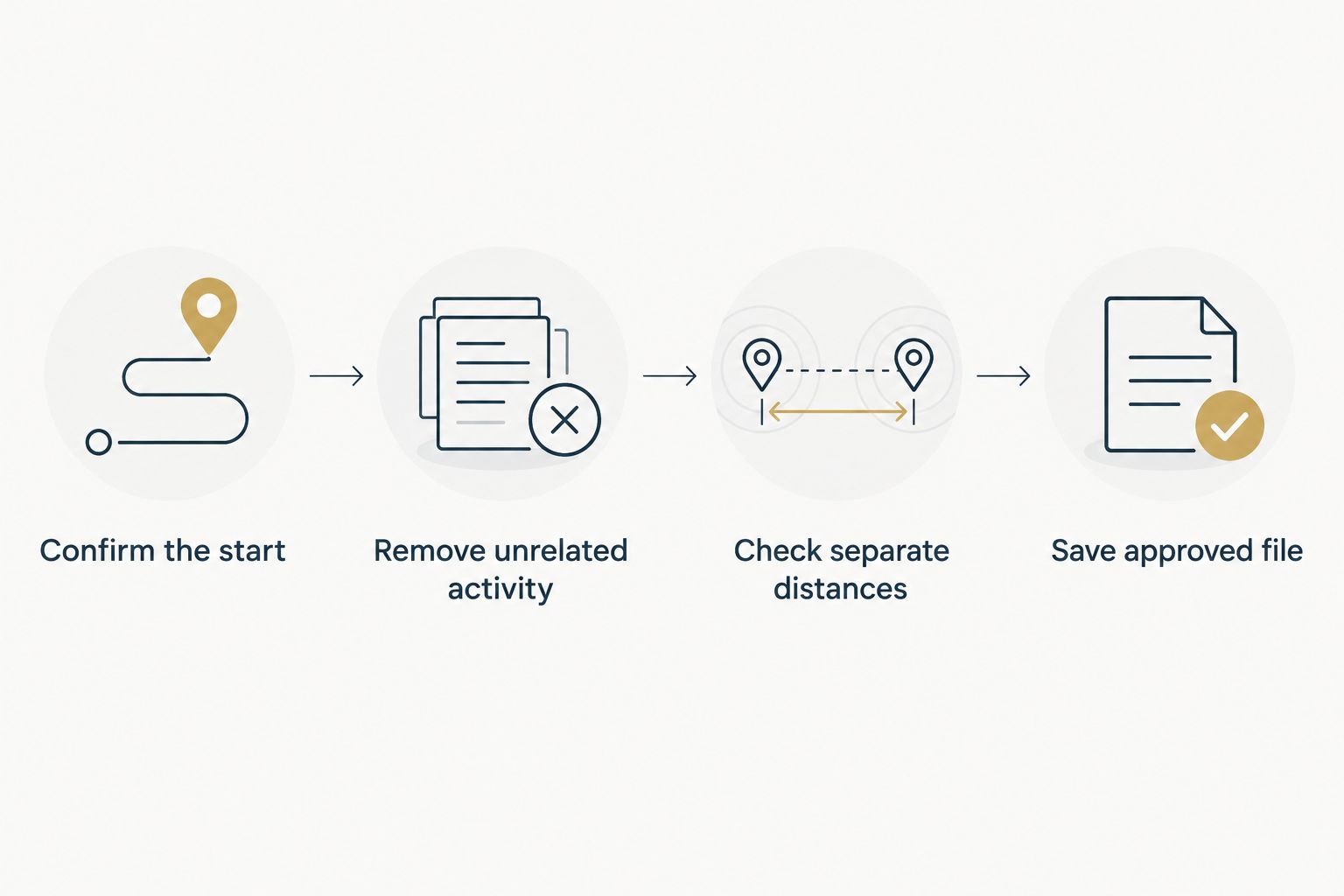
Open the course file in a mapping application and compare it with the approved event route. A participant’s recorded activity can contain a warm-up, wrong turn, or walk back to the parking area. A GPX file is useful evidence, not automatic proof that the course is correct.
Choose 1 master GPX file per course as your internal source of truth. Ask 2 reviewers—the course lead and the award approver—to check it independently. These are workflow recommendations, not supplier requirements.
If you change the course during 2026 planning, update the award brief too. A changed aid-station approach or rerouted trail section can leave your physical keepsake showing an earlier version.
- Confirm the start, finish, and direction of travel.
- Remove unrelated activity segments from the working route.
- Check separate distances against separate course files.
- Save the approved file with a clear version name.
Simplify personalization and verify permissions
Draft the wording in plain text before placing it into a design. Read it aloud. If the event name, cause, distance, sponsor, recipient name, and message all compete for attention, move supporting information to a separate card.
Ask what personalization the supplier can actually provide. Do not announce names, finishing times, logos, or individual donor totals on the award until the scope is confirmed. Participant-specific details also require a reliable source and an agreed correction process.
For a 2026 charity race, verify permission to use charity and sponsor marks with the relevant organizations. Keep the approval attached to the exact artwork version; approval of a name is not necessarily approval of every design treatment.
- Prioritize the course and essential event identification.
- Verify spellings against the approved recipient record.
- Request approval for charity and sponsor artwork.
- Keep sensitive participant information out of shared design files.
Review the physical format and distribution plan
Sketch the handoff process manually. Follow an award from its arrival through storage, sorting, volunteer collection, and participant pickup. This exposes practical questions that a design preview cannot answer.
A desktop sculpture and a wearable medal serve different presentation needs. Confirm the actual dimensions, material, handling instructions, and packaging before deciding how volunteers will distribute a route sculpture. Do not assume it is suitable for hanging around a participant’s neck or carrying through the finish chute.
Use 3 approval checkpoints in your internal plan: route, design, and distribution. Keep the responsibilities separate even if the same organizer signs off on each. A correct route does not prove the names are correct, and a correct design does not establish a workable handout plan.
- Ask for the format details needed to plan storage and handoff.
- Decide whether presentation belongs at the finish or a separate table.
- Give volunteers a written recipient-matching procedure.
- Set aside a process for damaged items and unresolved recipient questions.
Confirm the order and document changes
Compare the supplier’s written confirmation with your brief line by line. Check recipient groups, course versions, personalization, proof approvals, packaging, and the agreed event schedule. Resolve discrepancies before authorizing production.
For charity race finisher awards, deadline planning should work backward from the event’s actual handling needs. Your internal deadline must leave room for receiving, checking, sorting, and briefing volunteers. Use the supplier’s confirmed schedule rather than a generic production estimate.
Printmyroutes provides the custom route-sculpture format; your event team still owns course accuracy and participant eligibility. Keep those responsibilities visible in the order record so a last-minute change reaches the right person.
- Save the final written scope beside the approved course file.
- Record who authorized the design for production.
- Require written acknowledgment of subsequent changes.
- Prepare a participant communication plan for unresolved issues.
Explore your route sculpture
Review the custom route-sculpture option before confirming your charity event’s order requirements.
Compare award options for your charity race
Choose the format by the job it must do. The table compares recognition approaches, not supplier capabilities. Confirm specifications and order terms for whichever format you select.
| Option | Best for | Main strength | Key limitation |
|---|---|---|---|
| Printmyroutes custom topographic route sculpture | Course-centered keepsakes | Turns a GPS running, hiking, or cycling route into a physical sculpture | Requires an accurate route brief; event-order requirements need confirmation |
| Wearable finisher medal | Finish-line presentation | Can be worn immediately after the race | A medal format alone does not communicate the course’s terrain |
| Printed finisher certificate | Recognition centered on names and event details | Gives text and participant information a clear role | Does not provide a physical terrain representation |
| Separate finisher and fundraising awards | Events recognizing completion and fundraising independently | Keeps eligibility rules distinct | Requires separate records and clear volunteer instructions |
Do not force one award to perform every recognition role. If your main objective is immediate finish-line presentation, evaluate that need directly. If your objective is a course-specific display keepsake, evaluate route accuracy and the physical format instead.
For the 2026 event brief, record why the chosen format fits your recipient group. That explanation is more useful than a vague instruction to find something memorable.
Common mistakes charity race organizers make
Mixing completion with donation totals
A finisher and a top fundraiser have earned different recognition. State the criteria separately, especially if fundraising participation is optional. Otherwise, volunteers have to interpret a policy at the moment participants collect their awards.
Approving the wrong course version
An attractive preview can still represent an outdated route. Keep the approved GPX file attached to the design record and recheck both whenever the course changes. Never substitute a participant’s activity without reviewing it.
Promising customization before confirming it
Do not advertise recipient names, sponsor placement, or finishing times until the supplier confirms those details. Keep registration copy aligned with the agreed award scope. A compelling concept is not a confirmed production specification.
Treating the sculpture like a medal
Plan around the actual object, not the word award. Confirm handling and packaging requirements before assigning finish-line volunteers. If the sculpture needs a separate collection point, explain that process before event day.
Leaving the charity message to the object alone
The award does not need to carry the entire campaign story. An accompanying card or presentation can explain the cause while keeping the route readable. Ask the charity to approve that message as carefully as the physical design.
FAQ
What are the best charity race finisher awards?
The best charity race finisher awards match the recipient group and presentation method. A GPS-based route sculpture fits course-centered recognition, while a wearable medal fits immediate finish-line presentation.
Can a charity race use a GPX route for a 3D-printed award?
A GPX route can provide the course data for a custom topographic route sculpture. Verify the file against the approved event course and confirm the supplier’s file requirements before submitting it.
Is Printmyroutes suitable for a charity race keepsake?
Printmyroutes suits organizers considering custom topographic sculptures made from running, hiking, or cycling routes. Confirm event quantities, personalization, packaging, and scheduling directly before promising an award to participants.
Should every finisher receive the same award?
Use the same award when your eligibility policy gives every finisher the same recognition. If the event includes different courses or separate fundraising achievements, document whether those groups receive distinct versions.
Can we put our charity logo on a route sculpture?
Ask the supplier to confirm whether the proposed logo treatment is supported. Obtain permission from the charity and approve the exact artwork before authorizing production.
What if our charity race course changes after design approval?
Pause approval and send the revised course file to the supplier immediately. Request written confirmation of what can change and how the revision affects the agreed order schedule.
How should volunteers hand out route sculptures?
Use a distribution plan based on the confirmed physical format and packaging. Give volunteers a recipient list, a matching procedure, and a clear escalation process for missing or incorrect details.
One last thing
Approve the course before you approve the keepsake. The most carefully personalized sculpture still misses the point if it shows a route participants did not complete. Put the master GPX file, approved design, and recipient rules in the same event folder so your team can verify the whole award—not just its appearance.